Common rail injector repair & calibration
We test, clean, rebuild and calibrate Bosch, Denso, Delphi and Siemens common rail injectors on dedicated test benches — restoring correct spray pattern and fuel delivery before the unit goes back in your engine.
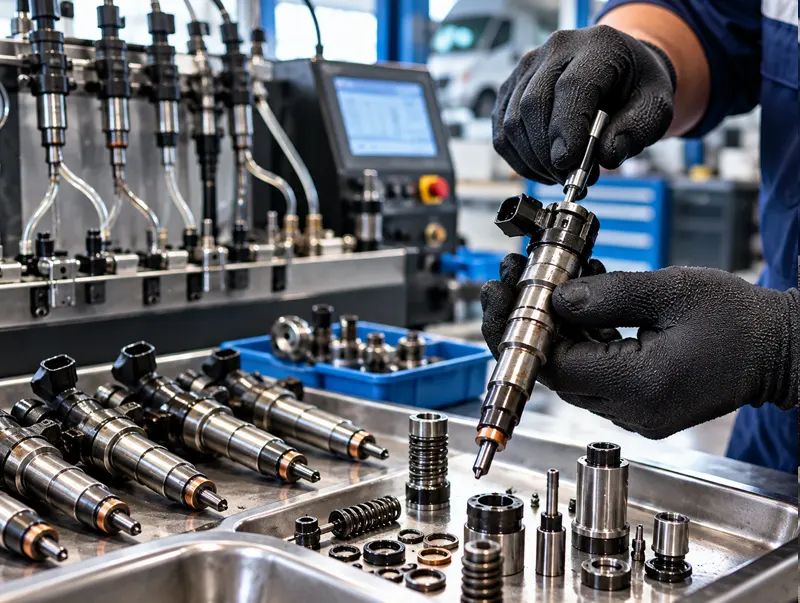
Diagnosed on the bench, not guessed at the counter
Common rail injectors run at extremely high pressure, and a small drift in spray pattern or return flow shows up as rough idling, poor power or excess smoke long before the injector fails outright. We remove the injector, strip it down and run it on a calibrated test bench to confirm the actual fault — sticking valves, worn nozzles, carbon build-up or electrical faults — before any parts are replaced.
Once repaired, every injector is re-tested against OEM flow and timing specification, so what goes back into your engine performs the same as new.
Core Repair Steps:
- Ultrasonic cleaning — removes carbon and varnish deposits from nozzles and internal passages.
- Flow & leak-off testing — measures delivery, return flow and internal leakage against spec.
- Component replacement — nozzles, valves, seals and washers replaced with OEM-standard parts as needed.
- Post-repair calibration — coded and calibrated on the bench to match your ECU's injector data.
Common rail injectors we service:
Full diagnostic testing, nozzle overhaul, and ECU code generation for passenger car and heavy-duty Bosch injectors.
Precision bench testing and valve replacement for Toyota, Mitsubishi, and Isuzu Denso injector systems.
Control valve reconditioning, coding and calibration for Ford, Hyundai, Kia, and Renault Delphi systems.
Electrical element test, nozzle cleaning and pressure calibration for Siemens/VDO piezo common rail injectors.
What a failing common rail injector looks like
Notice any of these? It's worth getting the injectors bench-tested before the fault spreads to other components.
Rough or uneven idling
A misfiring cylinder or noticeable engine vibration at idle often points to one injector delivering fuel incorrectly.
Excess smoke or fuel smell
Black or white smoke, or a strong fuel smell from the exhaust, is a common sign of poor injector spray pattern.
Loss of power or hard starting
Reduced delivery pressure shows up as sluggish acceleration, poor fuel economy or difficulty starting.
Engine warning light / fault codes
Injector correction or rail pressure codes stored in the ECU usually trace back to one or more injectors.
Knocking or ticking noise
A sharper, louder tapping from the injector rail can indicate internal wear or a sticking valve.
High fuel consumption
Injectors over-fuelling or under-fuelling cylinders unevenly will noticeably increase running costs.
From removal to re-calibration, in four steps
The same bench-first process for every common rail injector, regardless of brand.
Inspection & strip-down
Injectors are removed, cleaned externally and stripped down to inspect nozzles, valves and seals for wear or damage.
Bench testing
Each injector is run on a calibrated test bench to measure spray pattern, flow rate and leak-off against OEM figures.
Repair & rebuild
Worn components are replaced with OEM-standard parts, and internals are ultrasonically cleaned before reassembly.
Calibration & sign-off
The rebuilt injector is re-tested and coded to your ECU's injector data before it's cleared to go back on the engine.